Faded Paint, Honest Trade: How to Read Chirk’s Old Wall Lettering
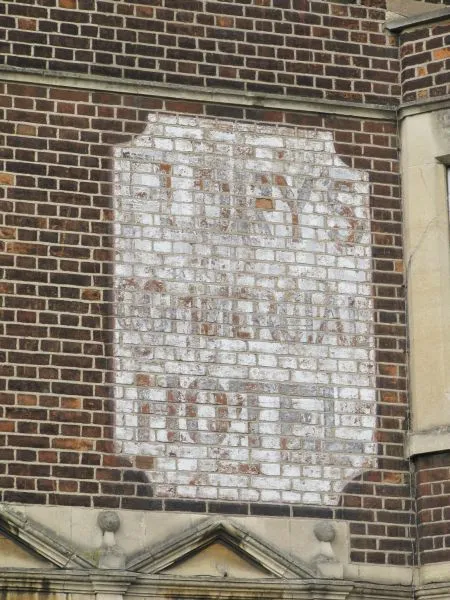
Photo: Bill Nicholls, CC BY-SA 2.0, via Wikimedia Commons
On a grey November afternoon in 2026, the village can look a bit monochrome. Then a low sun catches a wall on Church Street and suddenly there it is: a pale rectangle of old paint, a shadow of letters, a trade that closed before most of us were born. Chirk is not short of heritage set pieces — the castle, the aqueduct, the tunnel — but some of its most human history is stuck to the side of buildings in flaking lead paint.
These are the signs that signwriters left behind: grocer’s names, cycle agents, boot repairers, coal merchants, insurance agents and adverts for products that once seemed permanent. They are easy to miss and easy to misread. This is a field guide to looking at them properly, without turning a quiet residential street into an outdoor museum exhibit.
First, Look Up — And Slow Down
Most old wall signs sit above ground-floor windows or on gable ends, which is exactly where nobody looks. The trick is to walk a street twice: once at eye level, once with your chin up. Shopfronts get replaced, but the brick or render above them often survives. A faint rectangular outline, a band of slightly different coloured masonry, or a patch where the pointing is smoother than its neighbours can all be clues.
Use your phone camera as a low-tech magnifier. Zoom in on a patch of wall and you will often find the ghost of a border, a rule line, or the tail of a letter that is invisible from the pavement. Do this from public ground. You do not need to stand in someone’s drive, and you certainly should not lean over a garden wall to get a better angle. A long lens and a bit of patience are kinder than a trespass.
How to Date a Sign Without a Time Machine
You rarely get a date painted on a wall, but you can narrow things down. Start with the lettering style. Heavy Victorian serifs, ornate capitals and lots of shadowing tend to point earlier; plain sans-serif capitals and simpler layouts often belong to the twentieth century. Gold leaf and glass were prestige finishes; ordinary distemper and lead paint were the workaday option.
The products named in the adverts are another clue. Old signs for branded tea, cocoa, soap or tobacco can be roughly placed by when those brands were advertising heavily in a particular style. Local trade directories — held in record offices and some libraries — list shopkeepers by street and year, so a name on a wall can sometimes be matched to a name in a directory. The building itself helps too: Victorian brick, interwar render, later pebbledash. None of this is exact, but it is honest detective work rather than guesswork.
Reading the Trade Behind the Paint
Some signs are straightforward: the name of a shop and what it sold. Others are more revealing. A sign for a cycle agent tells you that the village had enough cyclists to support repairs and sales. A coal merchant’s name points to domestic heating and the railway sidings. A grocer and provision merchant reminds you that before supermarkets, a village street could supply most of a weekly shop.
Look for the small words as well as the big ones. “Agent for”, “licensed”, “depot”, “stores” and “family grocer” all carry meaning. So do the awkward gaps where a later signwriter painted over an earlier one. Chirk’s commercial past was not a single moment; it was layers. The canal, the railway, the coal trade and the castle estate all shaped what people bought and sold. A faded wall sign is a tiny receipt from that economy.
A Short, Respectful Circuit
The best approach is a loose loop rather than a tick-list. Start near the village centre and walk slowly along the main streets, scanning above shopfronts and on gable ends. Church Street and Castle Street are obvious starting points, but do not ignore the smaller lanes and the roads leading towards the station and the canal. Old signs survive where fashion and money have not reached.
The canal wharf area rewards a different kind of looking. Here the signs are less about shopping and more about movement: goods, haulage, storage. Do not expect a museum label. Expect a wall that has been repointed, painted and repointed again. If you find a sign you cannot read, photograph it flat-on and try adjusting the contrast later. Sometimes the letters appear in the camera roll rather than on the wall.
The Etiquette of Looking
These signs are on people’s homes, workshops and boundary walls. The rule is simple: public pavement, public view, no disturbance. Do not open gates, move bins, stand on walls or block pavements with a tripod. If someone is in the garden, a polite nod and a question from the pavement is fine; a lens pointed through a window is not. Keep dogs close and children closer.
Remember too that a faded sign is fragile. Do not rub it, chalk it, wet it or try to “clean” it for a better photograph. Lead paint and old render do not need your help. The pleasure is in the looking, not in the improving.
What the Signs Don’t Say
A ghost sign is not a complete history. It tells you what someone wanted to advertise, not how the business was run or who worked there. It flatters the past in the way all adverts do. But it does give a street a memory. It reminds you that Chirk was not always a place people passed through on the way to the castle; it was a working village with shops, deliveries, repairs and gossip.
So next time you are in the village, give the walls five minutes. Look up, slow down, and read the lettering that the weather has not quite erased. The best examples are not hidden behind a ticket desk. They are above the pavement, in the ordinary streets, waiting for someone to notice.