Soft Ground, Hard Border: A Late-Autumn Circuit on Chirk’s Offa’s Dyke
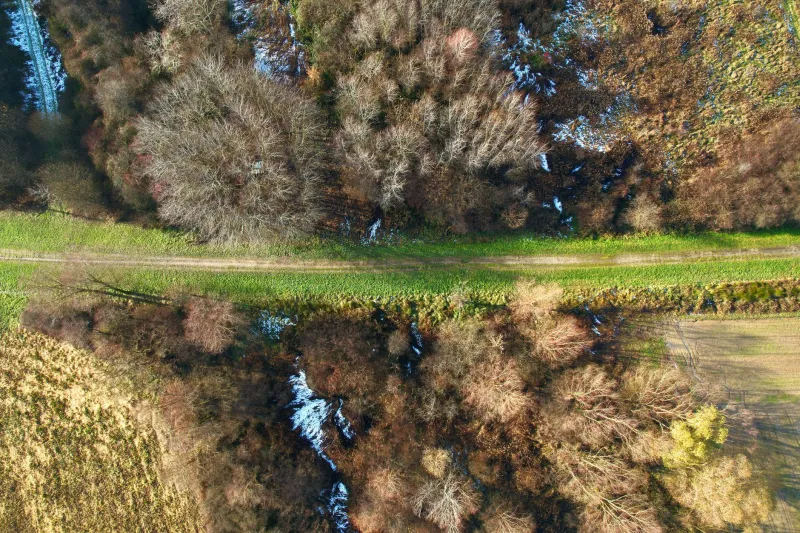
November is not the obvious month for a border walk. The leaves are down, the ground is soft and the light starts thinking about leaving by mid-afternoon. But that is exactly why the dyke shows itself now. With the hedges thinner and the grass flattened, the bank and ditch stop being a line on a map and become a shape you can actually see.
This is a short circuit from Chirk using the Offa’s Dyke Path. It is not a full day out. It is the sort of walk you can fit between lunch and the first proper dark, provided you go prepared for mud and do not treat the afternoon as elastic.
What you are actually walking
Offa’s Dyke is not a wall. It is a linear earthwork: a bank and a ditch, built in the late eighth century under Offa of Mercia. The idea was a physical border between Mercia and the Welsh kingdoms to the west. It never ran as a neat, continuous fence from sea to sea, and what survives today is fragmentary. Around Chirk, the dyke is often a low ridge in a field, a bank running under a hedge, or a wooded slope that looks slightly too straight to be natural.
The Offa’s Dyke Path is a long-distance trail, not the earthwork itself. The acorn waymarks follow the historic line where they can, then leave it when farms, roads or terrain get in the way. That distinction matters. You are walking a modern path through an old border landscape, not marching along the top of a scheduled ancient monument. In fact, you should not walk on the earthwork at all. Keep to the path, especially where the ground is wet and the bank is vulnerable.
Reading the earthwork in late autumn
The dyke is easiest to read when the leaves are off. Look for a long, deliberate bank with a ditch on the Welsh side and the bank on the English side — broadly speaking, though the line shifts and later land use muddles it. In places the ditch has silted up and the bank has been ploughed down. In others, a hedge has grown along the bank and preserved its profile.
Late autumn helps in another way. Mud shows you where people walk, and where they should not. If a line of churned ground runs along the top of a bank, that is not a shortcut; it is erosion. Stay beside it, not on it. The same goes for any section where the path crosses private land. Follow the waymarks, close gates and keep dogs under control around livestock.
The route: village, path, canal
A sensible short circuit is roughly four miles, depending on where you start in the village. Begin in Chirk and follow the acorn waymarks out towards the castle park and the higher ground beside the border. The path threads between fields and woodland, with the castle estate nearby and the Ceiriog valley somewhere below you. This is not a dramatic ridge walk. It is a quieter sort of border country: wet grass, low banks, big skies and the occasional clear view across to the English side.
After about a mile and a half, leave the long-distance path on a quiet lane and drop down towards the Llangollen Canal. Join the towpath and follow it back into Chirk. That return leg is a good late-autumn choice because the canal gives you a firm surface, a clear line to follow and an easy escape route if the light goes earlier than you expected. It also turns the walk into a loop rather than an out-and-back, which is more satisfying when the afternoon is short.
Check local signage on the day. Paths around the castle park and the canal can be diverted for maintenance or estate work, and the acorn waymarks are not a substitute for a map. The relevant OS Explorer sheet will show the lanes, the path and the towpath together. If you are unsure at a junction, take the lane rather than a muddy field edge. A slightly longer dry route is better than a short wet one in November.
Late-autumn practicalities
Mud is the main character. Wear boots with proper tread, not trail shoes you like too much. Gaiters are not overkill on the field sections. A single trekking pole helps on wet descents and saves you from the classic November slide. The ground around gateways will be worse than the ground in the middle of the field, so slow down there rather than trying to stride through.
Light is the second character. In mid-November, you want to be back in the village by about 3.30pm, not starting the towpath at 3.30pm. Take a headtorch even if you plan to be done in daylight. Cloud and rain can turn a grey afternoon into an early dusk. A small flask is not a bad idea either; the canal is colder than it looks when the wind comes down the valley.
Road crossings need proper attention. Where the path meets tarmac, stop, look and listen. Do not drift out from behind a hedge. Walk single file on lanes without verges and keep dogs close. If you are walking with children, treat each crossing as a meeting point rather than a race.
Finally, leave the earthwork alone. It is a scheduled monument, not a climbing frame. The best way to see it is from the path, with the low sun behind you and the leaves off the hedges. That is what November gives you: a clearer view, a softer ground and a border that is easier to read than it has any right to be.