Ears Before Eyes: A Late-Autumn Listening Walk Through Chirk
Most walks around Chirk ask you to look: at the castle, the aqueduct, the viaduct, the canal. This one asks you to listen. It is a small shift in attention, but it changes the day. In late autumn, with the leaves thin and the daylight short, sound carries further and clearer. You hear the things you normally walk past.
The route below is short enough for a November afternoon — roughly a mile and a half, with four planned pauses and a loose finish. It is free, it needs no booking, and it works best alone or in a quiet pair. Treat it as a sound map rather than a march.
Before You Set Off
Go in the afternoon, not the morning. Late autumn mornings can be muffled and dim; the middle of the afternoon has better light for the walk and a livelier mix of sounds. Aim to start around 2pm and finish before the light goes. In November, that gives you about two hours of comfortable walking, which is plenty.
Wear something you can stand still in. This is not a route for brisk pacing. A warm hat, a coat that does not rustle too much, and shoes that cope with damp grass are more useful than a map. Leave the headphones at home. If you bring a phone, use it for the time and nothing else.
One practical note: this is a working village and a working canal. Keep to paths, give cyclists and boaters room, and do not stand in the road to hear a train. The best listening is done from safe, ordinary places.
Stop One: Below the Castle Walls
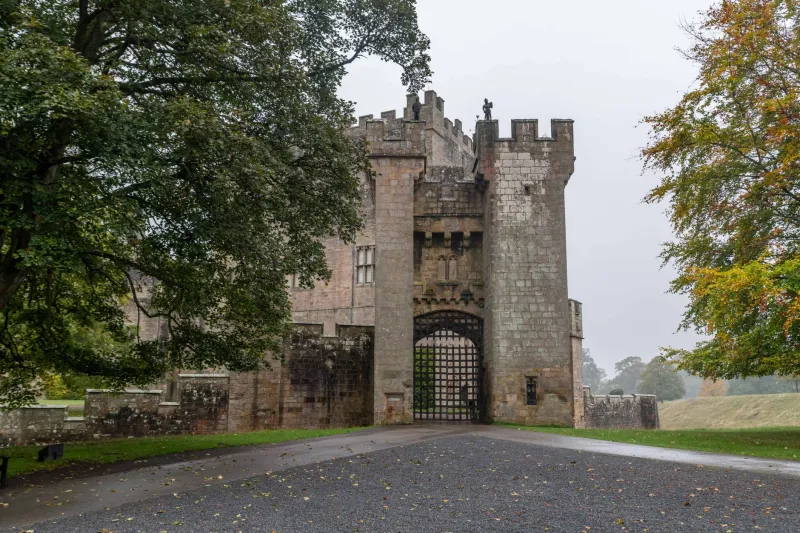
Start near the castle gates, but do not go straight in. Stand just outside, where the road meets the edge of the park, and give yourself two or three minutes of doing nothing. The first sound is usually the wind in the trees, then the jackdaws.
Jackdaws are the village’s resident commentators. They gather around the castle and the church tower, and in late autumn their calls are one of the defining sounds of Chirk. Listen for the short, clipped “chak” and the way one bird sets off another. It is not birdsong in the pretty sense; it is conversation, argument, gossip. You will hear it best when the leaves are off the trees and the birds are not hidden.
From here, walk a little way along the edge of the deer park, if the ground is not too wet. Do not try to do the full park circuit. This walk is about pauses, not distance. Find a spot where you can hear the castle behind you and the village below, and stay for a few minutes.
Stop Two: The Viaduct and the Ceiriog
The next stop is the river. Make your way down towards the Ceiriog, where the water runs under the old bridge and the railway crosses on its viaduct. This is the busiest sound spot on the route, and the most changeable.
The river itself is not a single sound. There is the flat wash over stones, the sharper note where water hits a ledge, and the hollow knock of something moving underneath. In November, after rain, it is louder and more urgent. In a dry spell, it turns into a low mutter.
Then there is the railway. The line between Shrewsbury and Chester crosses the Ceiriog on the viaduct beside the canal aqueduct, and a passing train is a proper event. You often hear it before you see it: a distant rumble that becomes a metallic hum, then a quick burst of noise as it crosses. Do not wait for one — check nothing, plan nothing, and let it arrive as a surprise. If you do hear one, notice how the sound changes as it moves away. It is one of the few moments in the village where you can hear distance itself.
Stop Three: The Canal and the Lock Gear
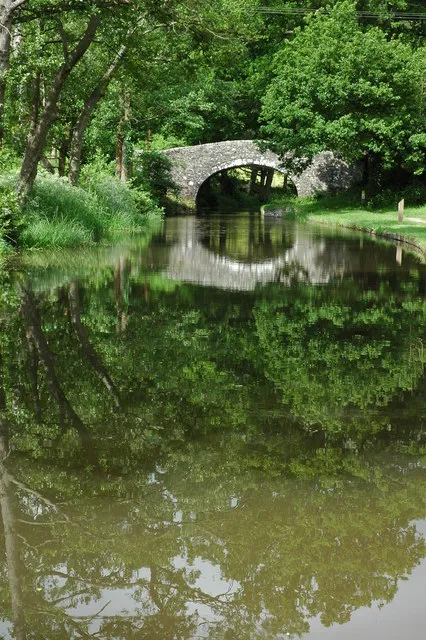
Walk up to the canal and follow the towpath for a short stretch. The canal has its own quiet rhythm: water lapping at the bank, the creak of a mooring rope, the low engine note of a narrowboat trying to be polite.
Near the lock, stop again. Lock gear is a wonderfully specific sound — the clank of a windlass, the ratchet, the rush of water as a paddle is lifted. If a boat is working through, stand back and listen rather than help unless you are asked. The sequence is almost musical: metal, water, effort, pause, then the slow creak of a gate. In November, with fewer boats about, you may get only one or two chances. That is fine. The canal is not a performance; it is a place doing its job.
Stop Four: Bells and the Ordinary Village
Finish by walking back into the village, towards the church. St Mary’s is the obvious landmark, and if you are lucky — a practice, a service, a wedding — you will catch the bells. Do not expect a concert. The pleasure is in the way bells sit above everything else: the traffic, the shop door, the dog on the pavement. They arrive from above and make the village feel briefly larger than it is.
If there are no bells, listen for what is left. A door closing. A kettle somewhere. The particular silence of a small town in the middle of the afternoon. Late autumn is good at that.
The Route, Roughly
Start at the castle gates; listen for five minutes. Walk down towards the Ceiriog and the bridges; listen for ten. Follow the canal towpath for a short stretch; listen at the lock for ten. Return through the village to the church; listen for five. The walking itself is easy, with a couple of slopes and some uneven ground near the river. Allow ninety minutes in total, including pauses. In wet weather, shorten it rather than abandon it — the river and the canal are even better in the rain.
A Few Listening Notes
Go with a question rather than a checklist. Which sound is furthest away? Which one is hardest to identify? Which one disappears when you stop moving? You do not need to answer. The point is to notice.
And if you hear nothing remarkable at all, that is still a result. Chirk in November is not a sound effects track. It is a village going about its business, with jackdaws overhead and water moving under the bridge. That is worth an afternoon on its own.