The Slow Lane: Reading Chirk’s Canal Stonework in Miniature
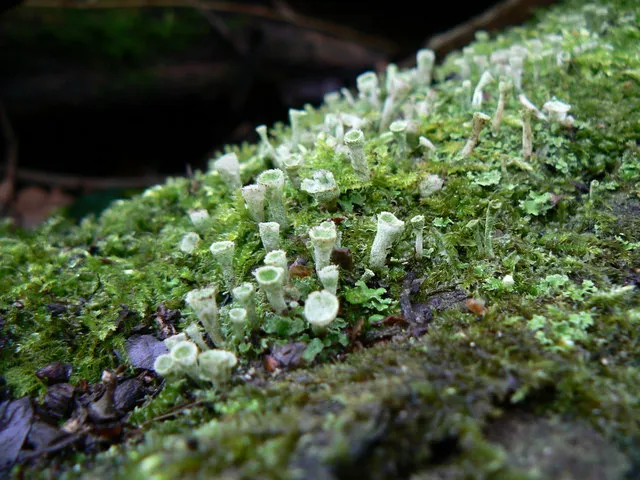
Photo: bernard bradley, CC BY-SA 2.0, via Wikimedia Commons
Chirk’s canal story is usually told in big gestures: the aqueduct, the tunnel, the long sweep of the Llangollen Canal. Quite right too. But there is a second, smaller canal walk available, one that asks you to stop looking at the valley and start looking at the wall in front of you. Moss, lichen and weather marks turn bridges, lock edges and aqueduct stonework into a kind of slow newspaper. You just need a hand lens, a dry-ish day and a willingness to stand still for a few minutes.
Start small, near the village
Begin at the canal in Chirk rather than marching straight for the aqueduct. Find a bridge or retaining wall near the village end and look at the stone at chest height, not at your feet. You are checking for three basic shapes: cushions, crusts and cups. Cushions are usually mosses, soft and pin-like when you get close. Crusts are lichens painted tight to the stone, often grey, green or orange. Cups are also lichens, with tiny disc-like fruiting bodies that look like miniature jam tarts.
A cheap hand lens is the whole kit. Hold it close to your eye, then move your head towards the stone until the surface snaps into focus. Phone cameras with a macro setting work too, but a lens slows you down in the right way. This is not a race. It is a winter walk for people who have already bagged the big views and fancy something quieter.
What the stone is telling you
The first thing you notice is damp. Moss likes a drink, so north-facing stone, shaded bridge undersides and the damp strip just above the towpath will carry more of it. Lichen is tougher and often takes the drier, more exposed faces. If one side of a bridge is green and velvet, and the other is grey and crusty, you are probably looking at a simple difference in sun and wind.
Shade matters as well. Trees along the canal keep moisture in and light out, which suits mosses and some leafy lichens. Open stone dries faster and tends to carry tighter crusts. Age is another clue, though not a straightforward one. Older mortar is rougher and more porous, giving tiny plants somewhere to grip. Repaired sections often look strangely clean by comparison, like a patch of new tarmac in an old lane.
Air quality is the fourth clue, and the one that needs the most care. Lichens are often described as pollution indicators, but the story is not simply ‘clean equals lichen, dirty equals none’. Some lichens thrive where nitrogen levels are higher, which is why orangey-yellow patches often appear on stone and bark in built-up areas. Others prefer cleaner air. Treat the colours as questions, not verdicts. The fun is in noticing the pattern.
A short route to the aqueduct
From the village canal, walk south along the towpath towards Chirk Aqueduct. Keep it simple and stop at three or four fixed points: the first bridge abutment you pass, a lock edge if one is nearby, a shaded retaining wall, and then the aqueduct stonework itself. At each stop, spend five minutes on one square metre of stone. That is all. You will see more in one small patch than in a mile of brisk walking.
On bridge stonework, look near the coping and around the arch springing, where damp lingers. On lock edges, check the vertical faces rather than the worn top stones. Near the aqueduct, the stonework is more exposed, so expect tighter crusts, grey-green tones and occasional orange splashes. The ironwork and rope marks are part of the same story, but leave those for another day. Today is about the green border between stone and air.
Common finds, without the Latin test
You do not need to identify everything. Try describing it instead. Is it a cushion, a crust or a cup? Is it grey-green, silver-grey, orange or yellow? Does it sit flat or stand up in tiny branches? Does it feel dry and brittle or soft and damp? Those notes will get you a long way, and they are more honest than a confident wrong name.
You will almost certainly meet wall screw-moss, with grey-green cushions and little upright stalks. Orangey-yellow patches are often a sunburst-type lichen, common on nutrient-rich stone. Grey crusts and small grey cups are everywhere once your eyes adjust. Foliose lichens, the ones with slightly leafy edges, tend to prefer damper, shadier spots. None of this requires a laboratory. It requires a bit of patience and a willingness to look slightly odd to passing dog walkers.
Look, record, leave alone
The golden rule is simple: do not pick, scrape or scrub. Moss and lichen grow slowly, and a tiny patch can be decades old. Take a photograph, jot a note, sketch the shape. If you want scale, place a coin or a lens cap beside the patch and photograph that, then remove it. Do not chalk outlines, do not wire-brush ‘just to see’, and do not peel anything off the mortar. The stonework is a working part of the canal, not a specimen shelf.
A phone note is plenty: date, weather, which bridge, which face, what colour and what shape. If you go back in a month, you will have a small record of how damp and shade shift through winter. That is real citizen science, done at walking pace, with no app required.
Finish with the big view
End at the aqueduct if you like, but before you take the usual photograph, turn round and look at the stone under your hand. The big view will still be there. The small one is the bonus. Chirk’s canal banks are not just a route from A to B; they are a habitat, a weather diary and a lesson in looking closely. Bring a lens, wear decent shoes, and give the green border ten minutes. It will repay you.