The Iron Trough and the Border Valley: Walking Chirk Aqueduct’s Anniversary
Anniversaries can be quiet things on a canal. There is no ticker tape on the towpath, no brass band on the abutment. But 2026 is the 225th year since Chirk Aqueduct opened, and that is as good an excuse as any to walk a short stretch of the Llangollen Canal and look properly at the thing rather than simply marching across it towards Llangollen.
This is not a guide to the full Pontcysyllte run. It is a birthday walk, a slow half-mile or so either side of the Ceiriog, with time built in for staring at stone, iron and the valley below. Bring boots, a flask and a willingness to stop in the middle of the towpath when something catches your eye.
What the ten arches actually did
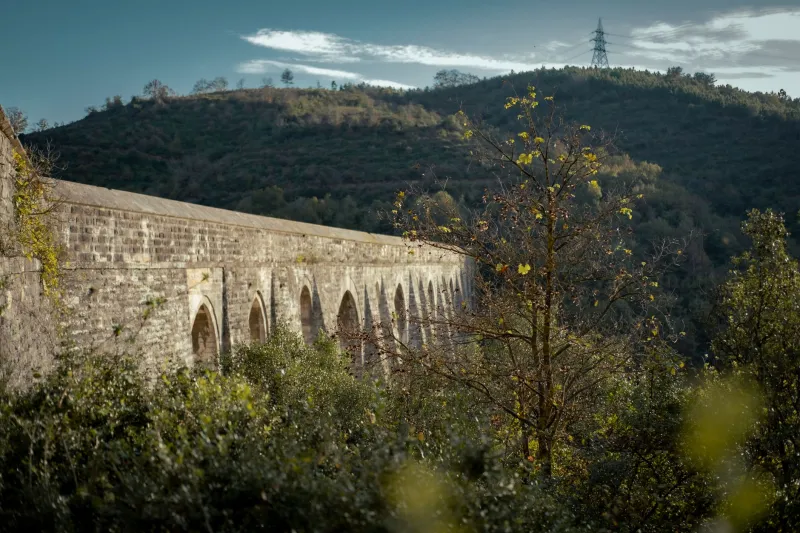
Before the aqueduct, the Ceiriog valley was a proper obstacle for the Ellesmere Canal. The canal wanted to keep a level line through border country that is anything but level, and the river gorge at Chirk was one of the awkward bits. Thomas Telford and William Jessop answered with a crossing that opened in 1801: ten masonry arches carrying a cast-iron trough high above the river.
The numbers are impressive enough. The aqueduct stands around 70 feet above the Ceiriog, and the trough itself is a long iron channel rather than a stone channel dressed up to look industrial. But the point was not showmanship. The crossing kept the canal on the level, kept boats moving, and tied the border country into a wider network of coal, lime, slate, timber and farm goods. It made the valley passable for trade without making it flat.
That is the thing to hold in your head as you walk towards it. Chirk Aqueduct is not a monument that happens to have water in it. It is a working piece of infrastructure that has been doing a job for more than two centuries, and it is now part of the Pontcysyllte Aqueduct and Canal World Heritage Site. The anniversary is a prompt to notice the graft, not just the view.
A short towpath itinerary, not a full route march
Start at Chirk Basin, where the canal feels like a village edge rather than a visitor attraction. Follow the towpath south. You will pass the tunnel mouth and then the character of the walk changes: the ground opens out, the valley drops away, and the aqueduct arrives as a line of arches rather than a single dramatic object.
Stop at the north abutment before you step onto the trough. This is the first good look at the masonry: the piers, the arch rings, the patched and weathered stone, the way the structure widens at its base to meet the ground. From here, the ten arches read as a rhythm rather than a count. Look left and right along the line and you can see how the canal keeps its level while the land does not.
Then cross. The towpath is narrow, with a handrail on the water side, and the Ceiriog is a long way below. Walk to the Chirk Bank side, turn around, and look back at the aqueduct from the south. This is the view that makes the iron trough legible: a dark, straight channel sitting on top of stone arches, with the railway viaduct nearby as a blunt reminder that the valley has been crossed by more than one kind of engineering.
If you have time, drop down towards the riverside paths for a lower angle. The aqueduct is often photographed from below, but the towpath view is the one that explains how it works. From the river, you see height. From the towpath, you see level.
Masonry, iron and the view back
The masonry is worth more than a glance. Look for the different tones in the stone, the lines of mortar, the places where repairs have settled into the original work. The arches are not identical when you get close, and the piers have a slight taper that makes the whole structure feel less like a wall and more like a series of legs standing in the valley.
The ironwork is the quieter story. The trough is made of cast-iron plates bolted together, and the edges show the practicalities of keeping water in a channel suspended in the air. The towpath railing, the fixings, the dark stained metal: none of it is decorative, but it is the reason the aqueduct looks the way it does. Telford and Jessop were not building a ruin for future walkers to admire. They were solving a watertight problem at height.
And then there is the Ceiriog itself. From the towpath, the river appears in glimpses between trees and banks, curving through the valley floor. In autumn and winter, when the leaves are thinner, the water catches the light and the aqueduct casts a long shadow. Look back towards Chirk Castle’s deer park and you get the full border-country picture: river, canal, railway, parkland and village all stacked into one view.
Practical notes for an anniversary visit
In November, the low sun can make the south side of the trough glow while the north side stays in shadow, so a mid-morning or early afternoon walk gives you the best contrast. The towpath can be muddy after rain, and the aqueduct itself is exposed. Wear something with grip and keep dogs close on the narrow section.
Chirk is easy to reach by train, and the canal is a short walk from the station. If you are driving, use the village or castle parking and walk down rather than trying to park at the aqueduct. There are no facilities on the crossing itself, so treat the basin or the village as your base for a cup of tea.
The aqueduct is free to walk across, and it is open all year. That is part of its charm. You do not need a ticket to stand on a 225-year-old piece of border-country engineering. You just need to slow down enough to notice it.
Why the birthday matters
Chirk Aqueduct is not a museum piece. Locals cross it because it is the way to the other side. Boaters pass over it because the canal goes that way. Walkers use it as a link between village and valley. The anniversary is not really about the date. It is about the fact that the structure has stayed useful for 225 years, and that the view from the towpath still explains the valley better than any panel or plaque.
So walk it slowly this year. Look at the stone. Look at the iron. Look at the river. Then look back at the ten arches and give them a quiet nod. They have earned it.