Wet Weather, Dry Feet: A Rainy-Day Plan for Chirk That Assumes the Worst
Photo: Sharon Mollerus, CC BY 2.0, via Wikimedia Commons
Most guides to Chirk assume a bright, still day. That is a mistake in a border valley where weather arrives over the Ceiriog from the west with very little notice. November is short on daylight anyway, and a plan that collapses at the first shower is not a plan.
So here is an honest one. It works in drizzle, in proper rain, and in the sort of sideways stuff that makes the aqueduct a bad idea. It is built on short legs, covered pauses, and a decision point in the early afternoon.
The rule of the day: ten minutes, then shelter
Forget the long loop. Break the day into hops of no more than ten or fifteen minutes on foot, with a roof at the end of each. Chirk is compact enough that this costs you very little — the village, the station and the canal are all within a comfortable walk of each other, and the walking is on pavements and made-up paths rather than open fields.
10.00 — Start at the station
Chirk station sits on the Shrewsbury to Chester line, and it makes a sensible wet-weather anchor: you can arrive by train without a soaking, and the sheltered platform gives you a dry read of the sky before committing. The station is small and not always staffed, so sort your ticket before you set off or use the machine. Access to the platforms is by ramp, but if you are relying on step-free routes, check ahead with the train operator rather than taking my word for it.
From here it is a short walk into the village. Ten minutes, if you do not stop to look at the viaduct.
10.20 — A village lap with eaves
A slow circuit of the centre takes about twenty-five minutes and can be done almost entirely under shopfronts, porches and high walls. It is not a heritage trail as such, but it does the job: you see the shape of the place, you stay dry, and you get the measure of how far everything is from everything else.
Two things worth a pause. First, the churchyard wall and gate — good shelter, good view of the tower, and a reminder that this village has been here a very long time. Second, any of the cafés or pubs on the main street. Going in early feels defeatist; it is actually good tactics. Build in one sit-down before eleven and the rest of the day stops feeling like a battle.
11.00 — St Mary's, and the dry half-hour
St Mary's Church in Chirk is old in the way that border churches are old — Norman work in the chancel, later additions layered on, a building that has been altered by every century that took an interest. The porch is a proper shelter, and the interior, when it is open during daylight hours, is the best dry hour in the village. Do not assume it will be unlocked; do not be put off if it is.
Access note: there are thresholds and uneven flagstones. A wheelchair or a pram will manage the main entrance but not every corner inside.
11.45 — The tunnel: the only genuinely weatherproof walk
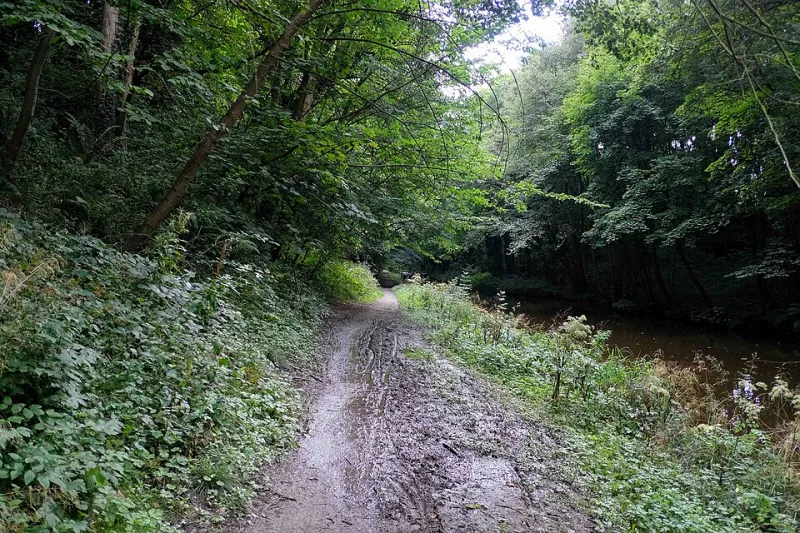
This is the centrepiece of a wet day, and people forget it exists. The towpath runs through Chirk Tunnel with a handrail on one side, and the tunnel is long enough — a few hundred yards — to feel like an expedition without any of the exposure. Rain does not get in. Wind does not get in. What gets in is dripping water, so a hood beats an umbrella.
A few honest notes before you commit:
- Lighting is limited. A phone torch is fine; a proper small torch is better.
- Headroom varies. If you are tall, keep your hood down and your eyes up.
- The path is narrow. Two people pass with care, not with ease. Cyclists should not be in there on a wet day, and mostly are not.
- The surface is uneven and wet. Boots, not trainers.
- There is a handrail. Use it. This is not the moment for pride.
Go through, come back, and you have banked forty minutes of walking in the dry. That is a good morning by anyone's standards.
12.30 — Lunch, and a decision
The decision point is simple. If the rain has eased and the wind is low, the aqueduct is twenty minutes away and worth the walk. If it is still hosing down or gusting, skip it. The aqueduct towpath is narrow, the handrail is on one side only, and the wind funnels along the trough. In bad conditions it is genuinely unpleasant and occasionally risky. There is no shame in leaving it for another day.
What to leave alone after heavy rain
This is the part most guides leave out. After a night of proper rain:
- The riverside paths along the Ceiriog. The river rises fast and the ground beside it turns to grease. Steps and boardwalks get slick.
- The aqueduct in wind. Already mentioned. It deserves repeating.
- The towpath south of Chirk Bank. Low sections collect water at culverts and under bridges; you will meet floods, not puddles.
- Grass paths in the deer park. Clay on a slope is a slip waiting to happen, and the light goes early.
- Rough ground around the old kilns and wharf edges. Wet grass hides drops.
Accessibility, honestly
Pavements in the village are a mix of tarmac and flagstone with kerbs at the crossings. The station has ramps but the route between village and canal involves gradients. The tunnel towpath is narrow with a handrail and a wet surface; it is passable with a companion and a torch, and easier on a dry day. Anyone with limited grip or balance should treat the canal entirely as a fair-weather option.
If it clears at three
Sunset in November arrives around half four, so a late break in the weather gives you perhaps an hour of decent light. Use it on the canal between the tunnel and the aqueduct, which is short, level and photogenic when wet, and be back in the village before the streetlights decide things for you. Bring a torch regardless. The best wet-weather days are the ones where nothing dramatic happens, and that is entirely down to the planning.