Arches Over the Ceiriog: How the Railway Shaped Chirk, and How to Arrive by It
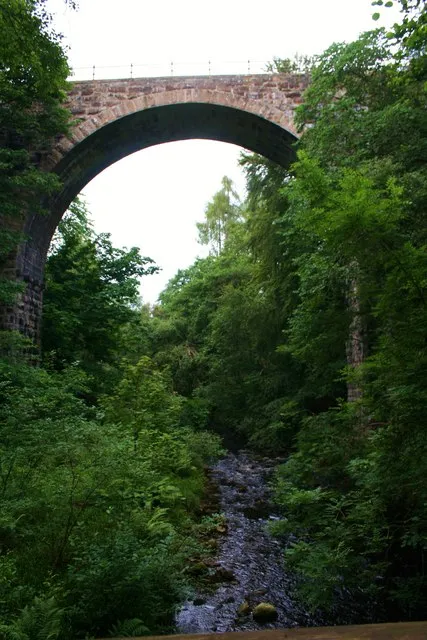
Photo: Andrew Wood, CC BY-SA 2.0, via Wikimedia Commons
Stand anywhere in Chirk with a clear line of sight to the south and the village will arrange itself around one structure. The castle sits up on its ridge, the canal crosses the valley on Telford's iron trough, and then — parallel, taller, unmistakably Victorian — the railway viaduct strides across the Ceiriog on its long run of arches. It is the sort of thing most residents stopped noticing decades ago and most visitors photograph before they have even parked the car.
That is worth pausing on. Chirk is a village of perhaps five thousand people with a castle, a World Heritage canal and a working railway station, and the railway is arguably the reason the other three are so easy to reach.
A line pushed through a border valley
The railway reached this stretch of the border in the 1840s, when the Shrewsbury and Chester Railway drove its route north through the Ceiriog valley towards Wrexham and the Cheshire plain. It was a speculative, competitive, faintly chaotic era of British railway building, and the engineering was done at speed and at height. Crossing a river valley meant either a long detour or a very large bridge, and the company chose the bridge.
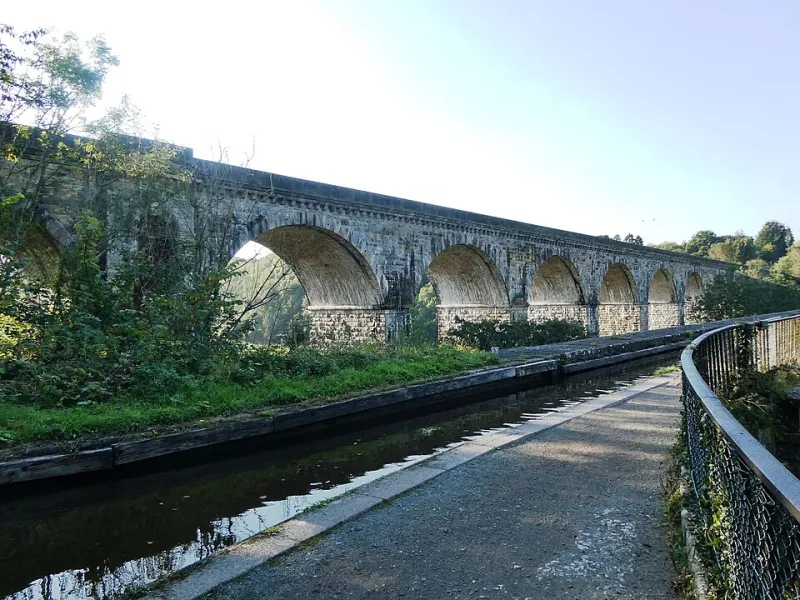
The result is the structure you see today: a long masonry viaduct, usually credited to the engineer Henry Robertson, standing roughly a hundred feet above the river and running close enough to the canal aqueduct that the two together read as a single piece of infrastructure. That proximity is no accident of taste. Two generations of engineers looked at the same problem — how do you get from one side of the Ceiriog to the other without losing height — and arrived at unnervingly similar answers, one in stone and iron for boats, the other in stone for trains.
The line was absorbed into the Great Western Railway in the 1850s, and the wide loading gauge and solidly built structures of that era are part of why the route still carries trains today when so many of its contemporaries became cycle paths.
Why the viaduct still stops people in their tracks
Most railway viaducts are best seen from a distance. This one rewards being underneath. Walk down towards Chirk Bank, where the lane drops to the river crossing, and the arches suddenly become enormous — each one framing a slice of sky, with the canal aqueduct visible just upstream carrying its slow procession of boats. Look up and you can catch the flash of a train crossing, which takes about fifteen seconds and is worth waiting for.
From the canal towpath the effect is different again. You are at aqueduct height, the railway is slightly higher and slightly to one side, and for a hundred yards you are walking through the middle of a piece of engineering history that most of the country has never heard of.
What to notice from the platform
Chirk station itself is a modest affair — two platforms, no ticket office, and a footbridge that gives you one of the best free viewpoints in the village. Do not rush straight out to the car park.
Stand at the southern end of the platform and look back along the line. You get the viaduct square-on, the castle grounds rising to the right, and the wooded dip of the Ceiriog below. It is a view that repays a few minutes even in the rain, and on a clear frosty morning it is genuinely lovely.
Look for the old station buildings and the remnants of a time when this was a staffed junction with goods traffic, coal, cattle and parcels. Chirk lost that world in the twentieth century, like almost everywhere else, but the bones of it are still legible if you know what you are looking at.
The best free viewpoints, ranked by effort
- The platform itself. Zero effort, best overall composition of viaduct, valley and castle parkland.
- The canal towpath between Chirk Basin and the aqueduct. Ten to fifteen minutes on foot from the village. The classic two-bridges photograph.
- The lane down towards Chirk Bank. The arches from below, which is how they were meant to be experienced.
- Chirk Castle parkland. A longer walk, but the view back across the valley puts the whole arrangement — castle, canal, railway — in one frame.
Arriving without a car: a platform-to-castle plan
This is where Chirk quietly outperforms its size. Services on the Shrewsbury to Chester line call here roughly hourly through the day, run by Transport for Wales, with Wrexham about ten minutes away, Chester around half an hour, and Shrewsbury something over forty minutes. Gobowen, the other station serving the area, is a short hop south.
A workable day out looks like this. Step off the train mid-morning and walk down into the village for a coffee — the centre is only a few minutes away and mostly downhill. From there, follow the signed route to Chirk Basin and pick up the canal, walking north-west to the aqueduct for the double crossing of the Ceiriog. Come back along the towpath, then take the long drive up through the parkland to the castle, allowing half an hour each way at a stroll.
That is a full day — canal, aqueduct, viaduct, castle — with no car, no parking charges and no arguing about the Sat Nav. The only genuine constraint is the timetable, so check the last trains back before you settle in anywhere for the evening.
Practical notes before you go
Chirk is unstaffed, so buy a ticket before you travel if you can, or pay on board where that is permitted. There is step-free access to at least one platform but the footbridge involves stairs, so allow extra time if you need it. The walk from the station to the village is short but steep in one direction, and the walk to the castle is longer than most people expect.
One point of confusion worth clearing up: Chirk is on the Shrewsbury to Chester line, not on the Borderlands Line between Wrexham and Bidston, which serves a different set of villages to the north. Visitors who mix the two up tend to end up somewhere flat and windswept with a long wait.
And finally, a small plea. If you are on the platform and a train is due, look up from your phone. Somewhere between the announcement and the doors closing, there is a view of a Victorian viaduct over a border river that people travel a long way to see. It is yours for the price of a ticket, and it has been running to schedule, more or less, since the 1840s.